
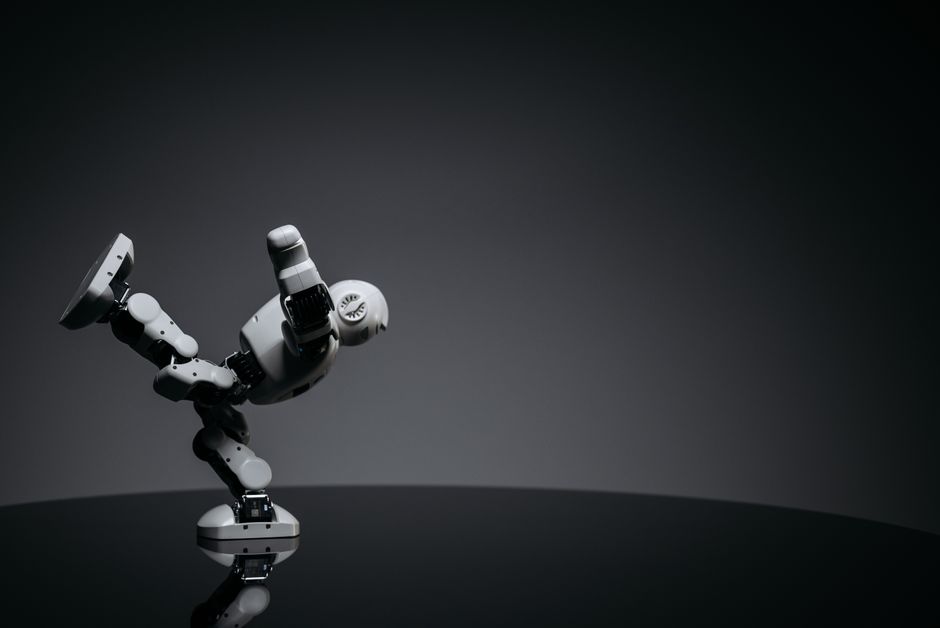
A robot does one perfect backflip on camera, the video goes viral, and the company's stock soars 460%. Then the CEO goes on record and says the quiet part out loud: we are still years away from robotics having its own 'ChatGPT moment.' That single sentence is more useful to founders and investors than the viral clip itself, because it draws a hard line between a rehearsed trick and a general-purpose machine — and most people are still investing in the trick.
What is the Concept
A 'ChatGPT moment' is shorthand for the point where a technology crosses from impressive demo to general-purpose tool that non-experts can direct in plain language and trust with real-world tasks, without custom engineering for every new situation. For large language models, that moment arrived when a chatbot could follow arbitrary instructions across countless domains reliably enough for millions of people to use it daily. Robotics has not had that moment because physical dexterity, spatial reasoning, and safe real-world adaptability are far harder problems than generating text — a robot doing a backflip has been trained and choreographed for that exact routine, not given a general instruction like 'clean this warehouse' and left to figure it out.
This is the gap the CEO in this story is pointing at. A viral stunt proves the hardware and control systems can execute a complex, pre-planned motion. It does not prove the robot can generalize to new tasks, new environments, or ambiguous instructions the way an LLM can generalize across topics it was never explicitly trained on.
Why It Matters Now (2025–2026 Context)
Humanoid robotics has become one of the most heavily funded categories in tech, with venture capital, public markets, and industrial buyers all racing to back the next big platform. A 460% stock move on the back of a single demo video shows how fast capital moves when a video looks like proof of general intelligence, even when the underlying capability is narrow. That mismatch between market enthusiasm and technical readiness is exactly the pattern that preceded painful corrections in past hype cycles, from early self-driving car valuations to first-generation chatbot startups that overpromised autonomy they could not deliver.
For business leaders, this matters because robotics vendors, automation consultants, and even internal teams are increasingly pitching 'AI-powered robots' as near-term solutions to labor shortages and rising operating costs. Understanding the real distance between a viral demo and a deployable system is now a basic due-diligence skill, not a nice-to-have.
How AI Is Changing This
The reason a genuine robotics ChatGPT moment is plausible at all is that large language and vision models are increasingly being used as the 'brain' that sits on top of robotic hardware, translating natural-language goals into action sequences. This is a real shift: instead of hand-coding every movement, engineers are training foundation models on video and sensor data so robots can generalize across tasks the way LLMs generalize across text. Companies working on this layer are effectively trying to give robots the same kind of broad, instruction-following capability that made ChatGPT usable by non-programmers overnight.
The honest limitation, and the one this CEO is flagging, is that physical generalization requires orders of magnitude more real-world trial data than language generalization did, because the cost and risk of a robot failing in the physical world is far higher than a chatbot giving a wrong answer. That data collection problem — not compute, not ambition — is the actual bottleneck slowing the timeline down.
Real-World Examples
The pattern in this story mirrors what happened across the AI industry before large language models matured: narrow, impressive demos attracted huge valuations years before the technology could reliably generalize. Early chatbot companies in the 2010s could hold a scripted conversation convincingly, which fueled funding rounds, but they collapsed the moment a user asked something outside the script. The lesson investors eventually learned was to separate 'can perform this specific trick well' from 'can be directed to do anything reasonable within its domain.' Humanoid robotics is now at the stage those chatbot companies were at roughly a decade earlier — capable of stunning specific feats, not yet capable of open-ended instruction-following.
The 460% stock reaction described in this story is a real-world signal of how markets currently price robotics: on spectacle rather than deployment metrics like uptime, task generalization rate, or cost per completed task in a live facility. Founders evaluating robotics vendors should ask for those deployment metrics directly instead of accepting a demo reel as proof of readiness.
Practical Insights / Actions
This is a good moment to apply what can be called the Hype-to-Utility Curve: plot any AI or robotics claim on two axes — how impressive the demo looks, and how many unscripted, real-world conditions it has actually been tested in. A backflip sits high on spectacle and low on unscripted testing, which is exactly the danger zone where capital moves fastest and disappointment risk is highest. Before allocating budget or investment to a robotics vendor, ask three questions: how many distinct environments has the robot operated in without custom reprogramming, what is the failure rate outside the demo conditions, and can it accept a plain-language instruction it wasn't specifically trained for.
There is also a specific trap worth naming here — call it Backflip Bias: the tendency to treat a single, highly-rehearsed physical stunt as evidence of general intelligence, simply because it is visually spectacular in a way a spreadsheet of benchmark scores is not. Founders and operators make this mistake when they green-light six- or seven-figure automation contracts based on a sales demo rather than a pilot run in their own facility. The hidden opportunity is the opposite move: companies that quietly run small, unscripted pilots on current-generation robotics or process-automation tools — rather than waiting for a mythical 'ChatGPT moment' in robotics — are already capturing real efficiency gains today, without paying the hype premium.
Future Outlook
The CEO's own admission — that a ChatGPT moment for robotics is still years out — is a more credible signal than the stock price itself, because founders rarely talk down their own valuation unless the gap between perception and reality has become hard to ignore. Expect the next 12 to 24 months to bring a divergence between hardware companies chasing viral moments and software-layer companies quietly improving the instruction-following 'brain' that will eventually make general-purpose robots viable. The winners of the eventual robotics ChatGPT moment are more likely to be whoever solves real-world data collection and safe generalization first, not whoever has the most-watched demo video.
For most SMEs and founders, the practical takeaway is not to bet on humanoid robots reaching general capability on any specific timeline, but to stay close enough to the space to move quickly once deployment metrics — not demo reels — start proving out.
Conclusion
A 460% stock surge on the back of a backflip video is a story about market psychology, not robotic intelligence — and the CEO's own admission confirms it. The businesses that win in this next wave of automation won't be the ones chasing viral demos; they'll be the ones applying disciplined frameworks like the Hype-to-Utility Curve to separate spectacle from deployable value. If you're evaluating AI or automation investments for your business and want a second opinion grounded in deployment reality rather than demo reels, RP SoftTech can help you audit what's actually production-ready today.